
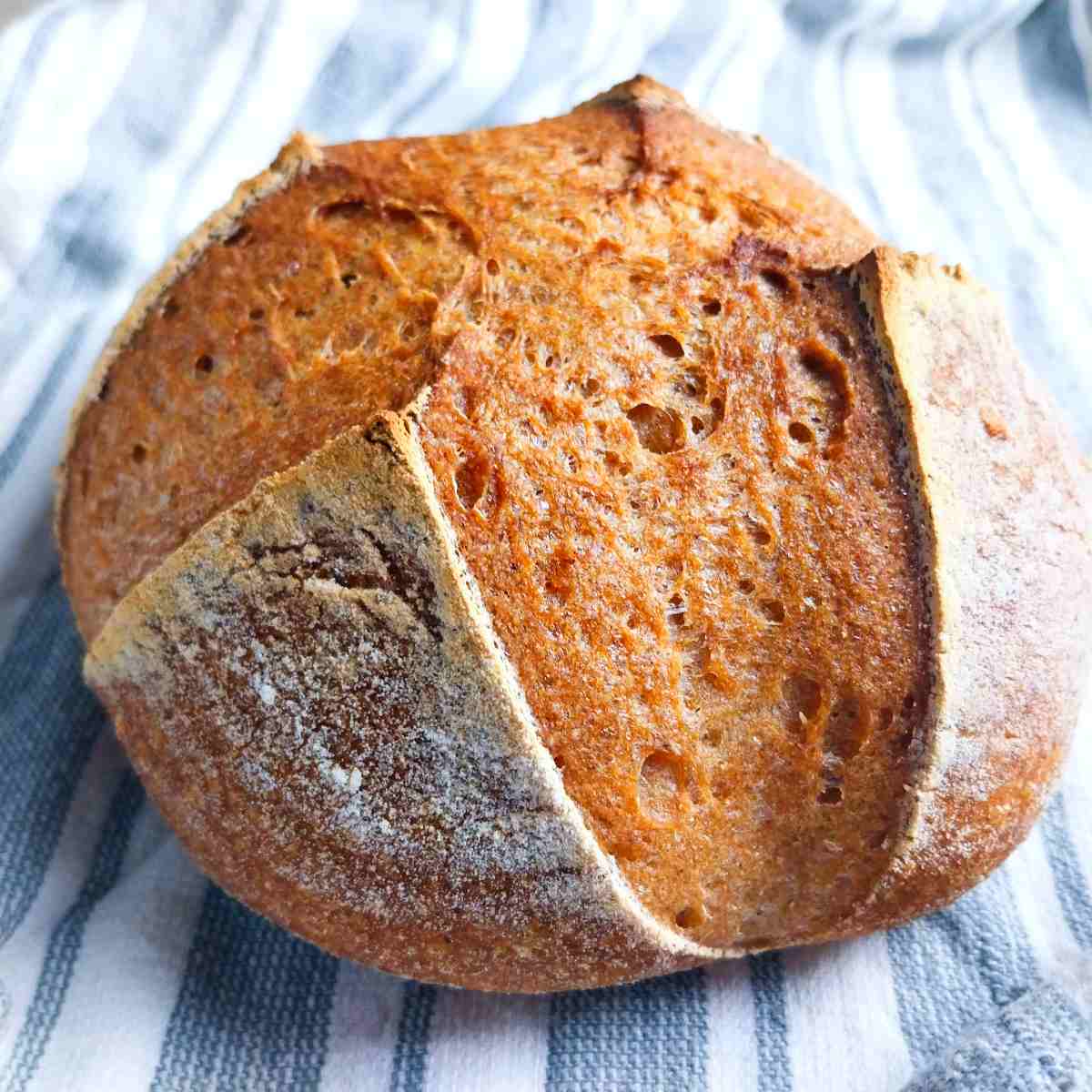
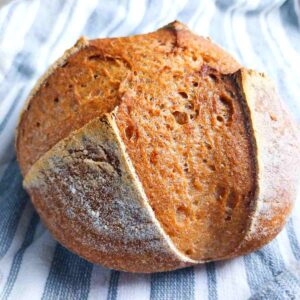
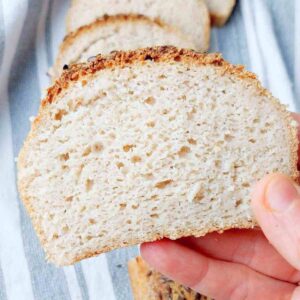
This vegan gluten-free sourdough bread is soft, fluffy, nutritious, and perfectly crusty! Once you master the skill, you will never go back to the store-bought gluten-free bread.
Jump to:
- Sourdough vs. Commercial Yeast
- Gluten-Free Starter
- Psyllium Husk
- Sourdough Terminology Explained
- 🍽 Tools You Might Need
- The Best Flour for GF Sourdough
- A note on flour types
- 🥘 Ingredients
- 📖 Substitutes
- 🔪 Step-by-step instructions
- Troubleshooting
- Frequently Asked Questions
- More Gluten-Free Sourdough Recipes to Try
- Get my GF sourdough recipes eBook
- Gluten Free Vegan Sourdough Bread
- 💬 Community
Sourdough vs. Commercial Yeast
Sourdough bread uses naturally grown yeast with wild bacteria that is naturally found in the air around us and in water and flour used to make a starter.
Commercial yeast is a single strain of bacteria created in a lab to speed up the fermentation process.
While commercial yeast is easier to use, sourdough will provide a unique flavor, more nutrients, and an authentic experience of artisan bread baking.
New to gluten-free sourdough? Watch my 16-minute video tutorial for beginners!
Gluten-Free Starter
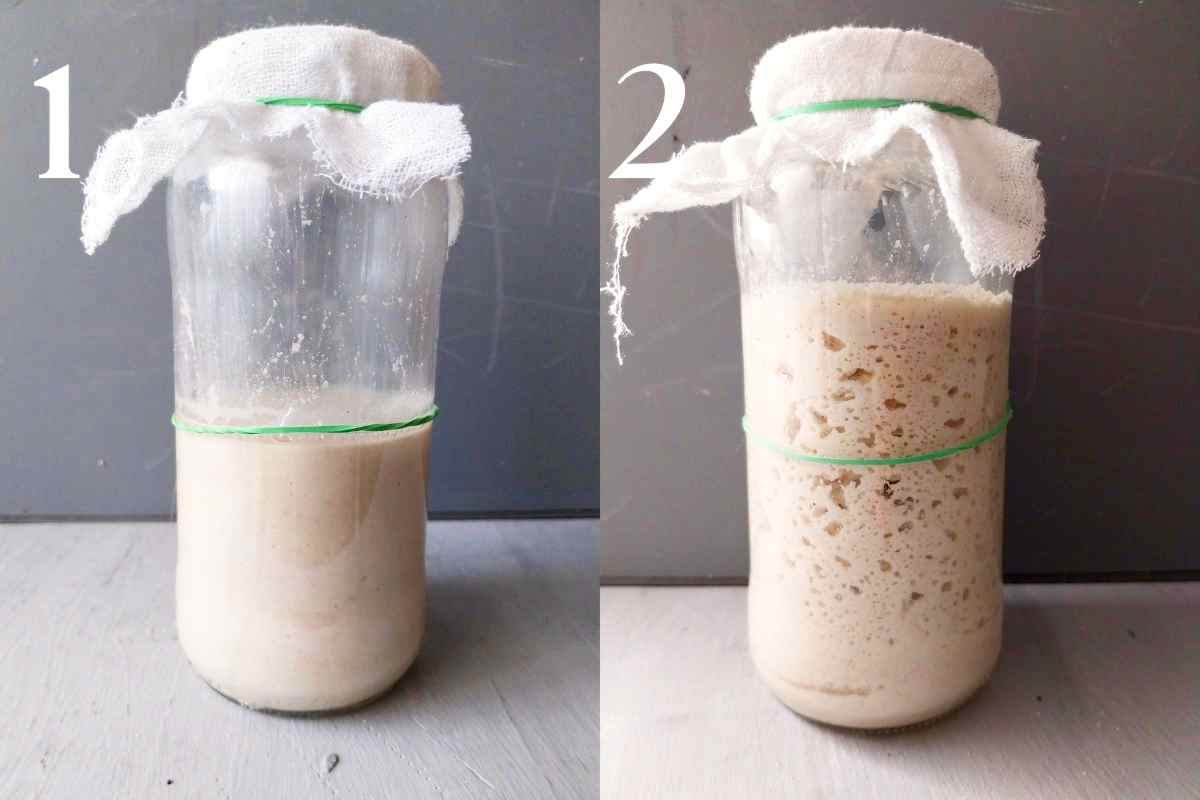
You will need an active starter for this recipe, if you don't have a starter yet, make sure to read my minimal waste starter guide.
You can use any starter you have, I personally find sorghum flour starter and brown rice starter work best, but you can experiment with other types (like millet) as well.
Psyllium Husk
While some recipes use xanthan gum, I prefer using psyllium husk as a binder in gluten-free sourdough bread. I wrote more on this wonderful ingredient in my psyllium 101 article!
If you can't have psyllium, you might be able to use Konjac instead, although it makes the dough more crumbly, less shapable, and less stable.
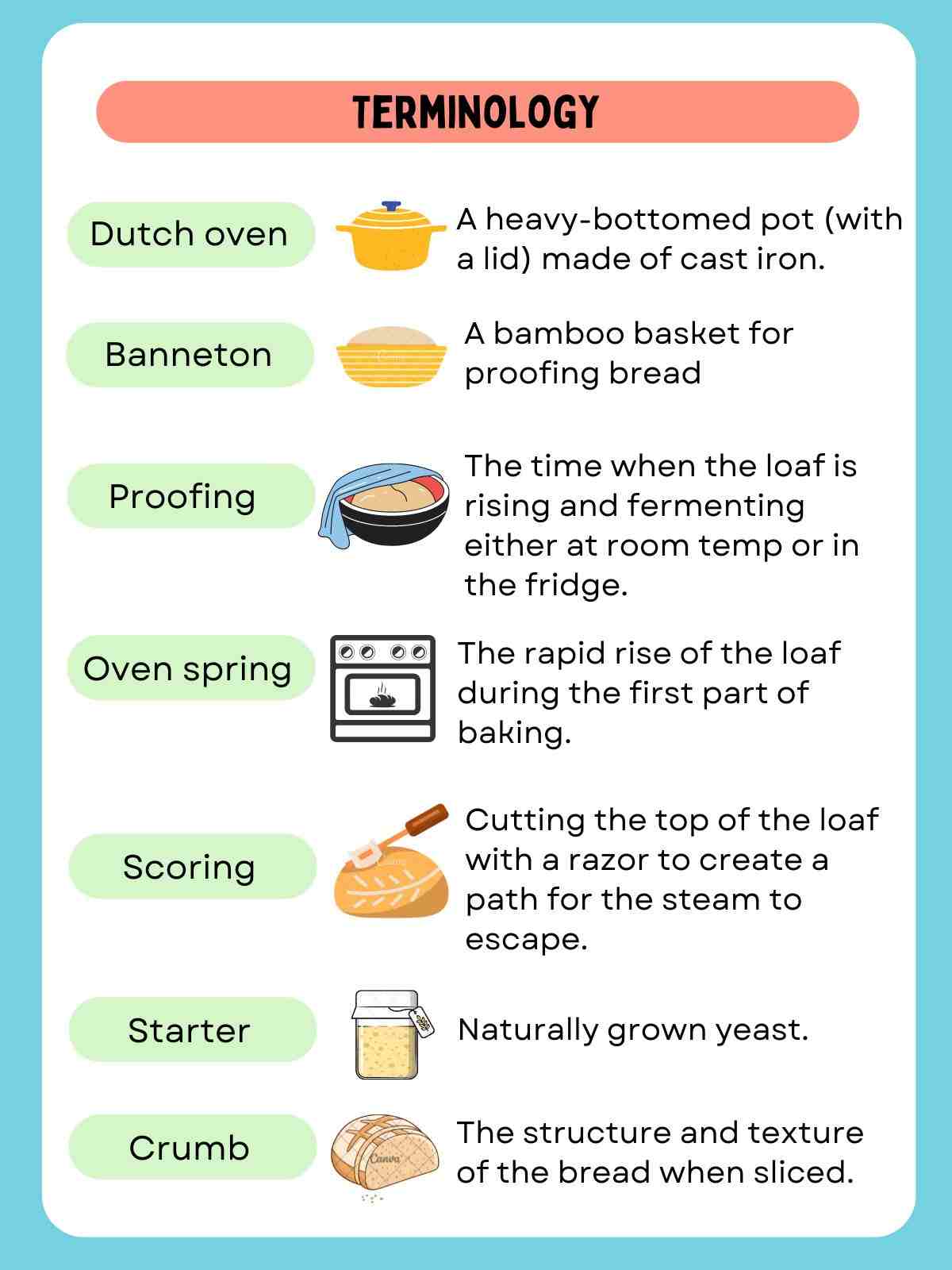
Sourdough Terminology Explained
🍽 Tools You Might Need
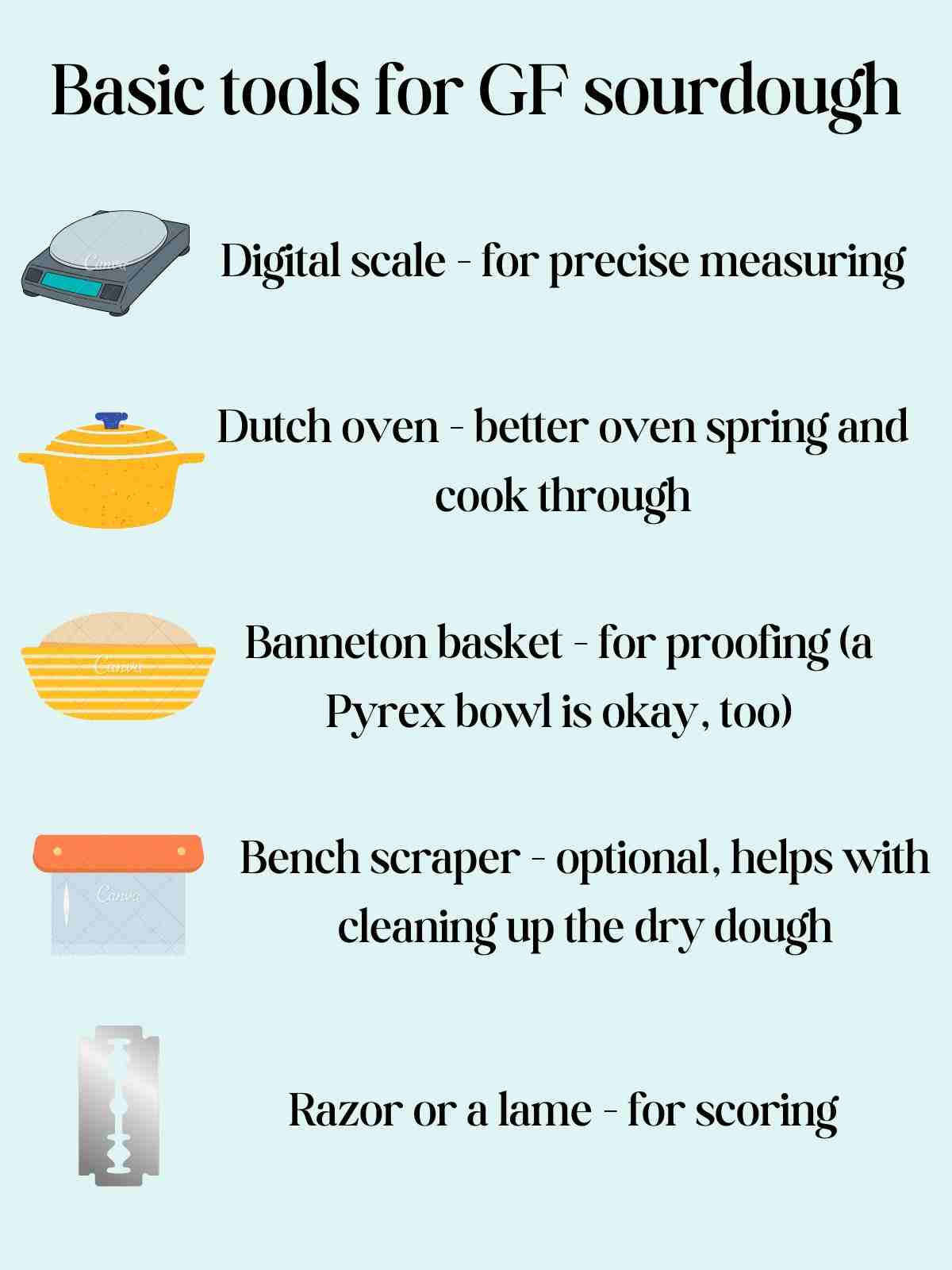
- A Dutch oven. You can also use a cast iron pan/baking sheet with a dish filled with water at the bottom to create extra steam during baking.
- A digital kitchen scale. I don't provide the cup measurements because it is so important for gluten-free sourdough to be measured by weight and not by volume!
- A banneton basket allows for a pretty pattern and better breathing of the dough. You can use a mixing bowl lined with a kitchen towel instead if you need to!
- A bench scraper. This tool is amazing when it comes to cleaning up the doughy mess off of the kitchen counter!
The Best Flour for GF Sourdough
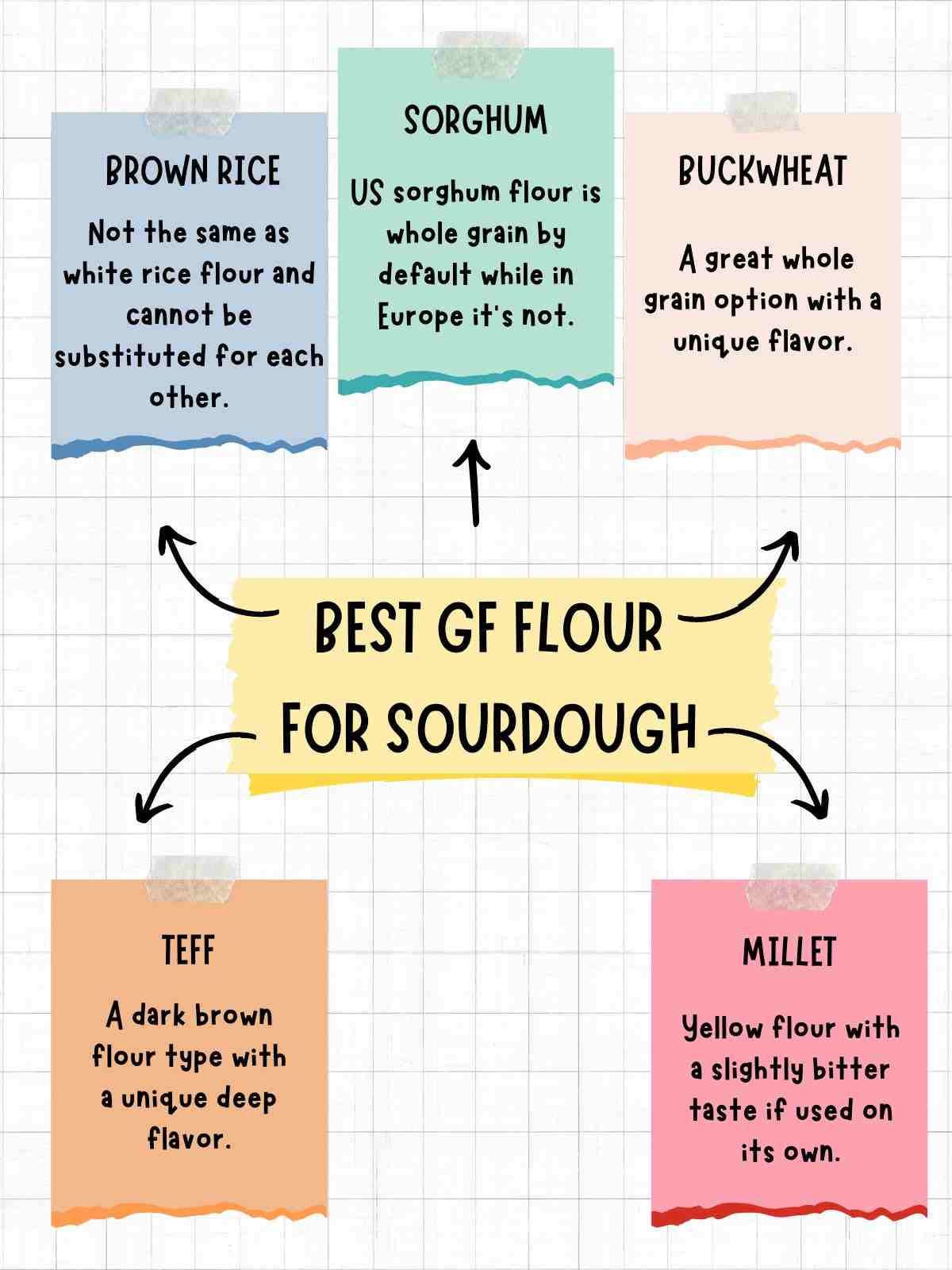
Almond and coconut flours are not the best for making sourdough bread because of their low carb content. You can, however, add some starter to my almond bread recipe if you need a keto sourdough recipe!
A note on flour types
It is important to add starches like potato, corn, tapioca, or arrowroot to the dough for a fluffier crumb. If you can't have starches, check out my 100% millet, 100% sorghum, and 100% brown rice flour sourdough recipes.
🥘 Ingredients
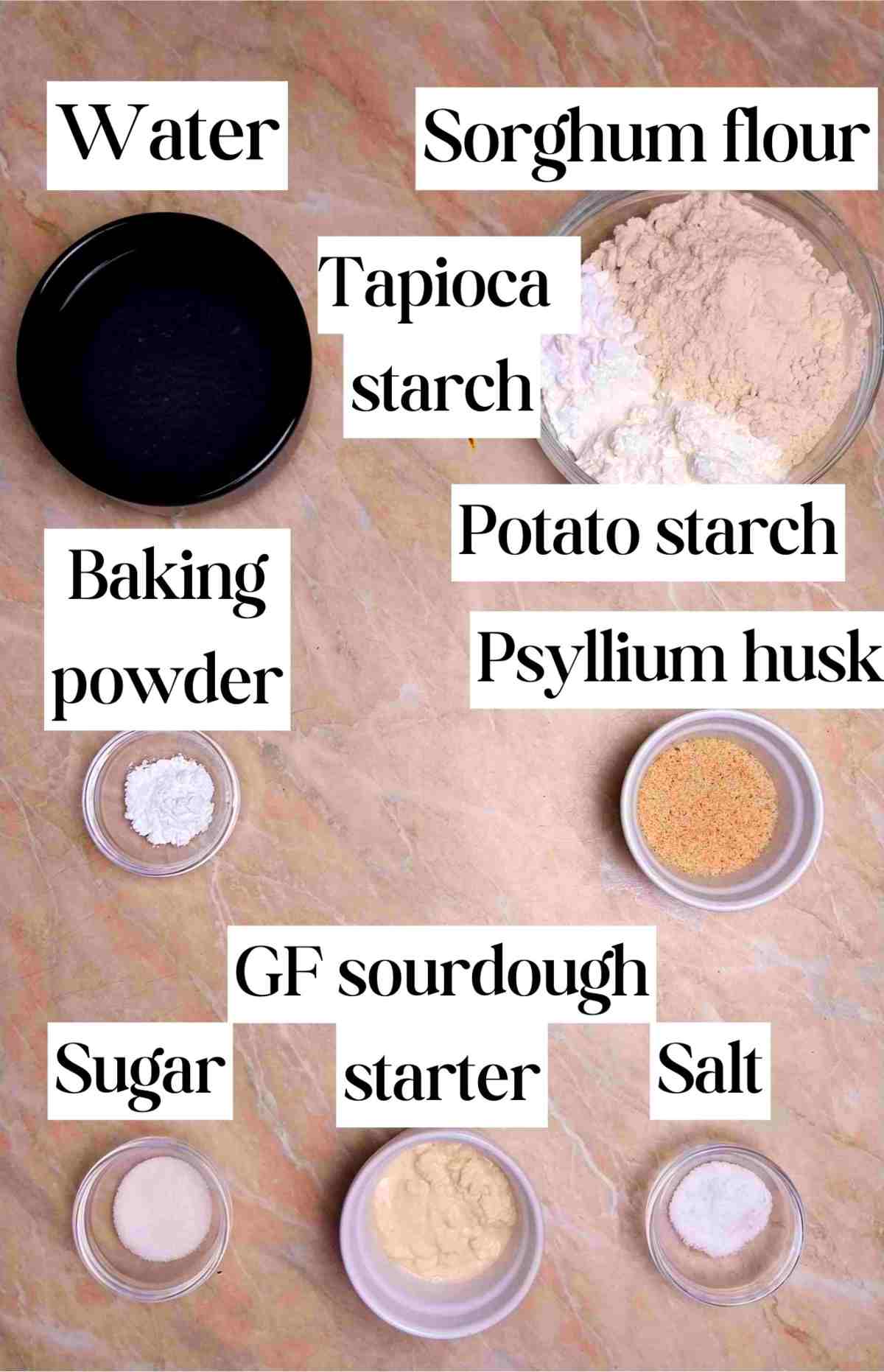
Gluten-free sourdough starter - use a mature starter that is at its peak activity, meaning when it is at its highest point of rising. Check out my gluten-free sourdough starter recipe if you don't have one!
Psyllium husk - you can use whole husks or powder. I prefer baking with whole husks as they are very easy to handle. But if you only have powder, then try avoiding very fine powder and opting for the coarser variety instead. For more information refer to my article about psyllium husk in baking.
Water - use room temperature water for the best results. I use tap water with no problems but if your tap water has chlorine in it, you will need to use filtered or bottled water.
Sorghum flour - European brands tend to be lighter than the US ones. You can use either sorghum flour, the results will be the same!
Starches - tapioca starch adds softness and chewiness to the texture while potato starch adds lightness to the loaf.
Baking powder - optional, but it helps raise the loaf and get more air in the bread.
Sugar - it is used for bacteria to feed on.
📖 Substitutes
Flour - feel free to experiment with other flour types keeping in mind that some of them might need more water than others!
Psyllium husk - I don't recommend substituting psyllium husk. You can use psyllium powder instead but keep in mind it might clump and/or turn your bread purple.
Sugar - use the same amount of maple syrup or honey in place of sugar.
🔪 Step-by-step instructions
Step 1
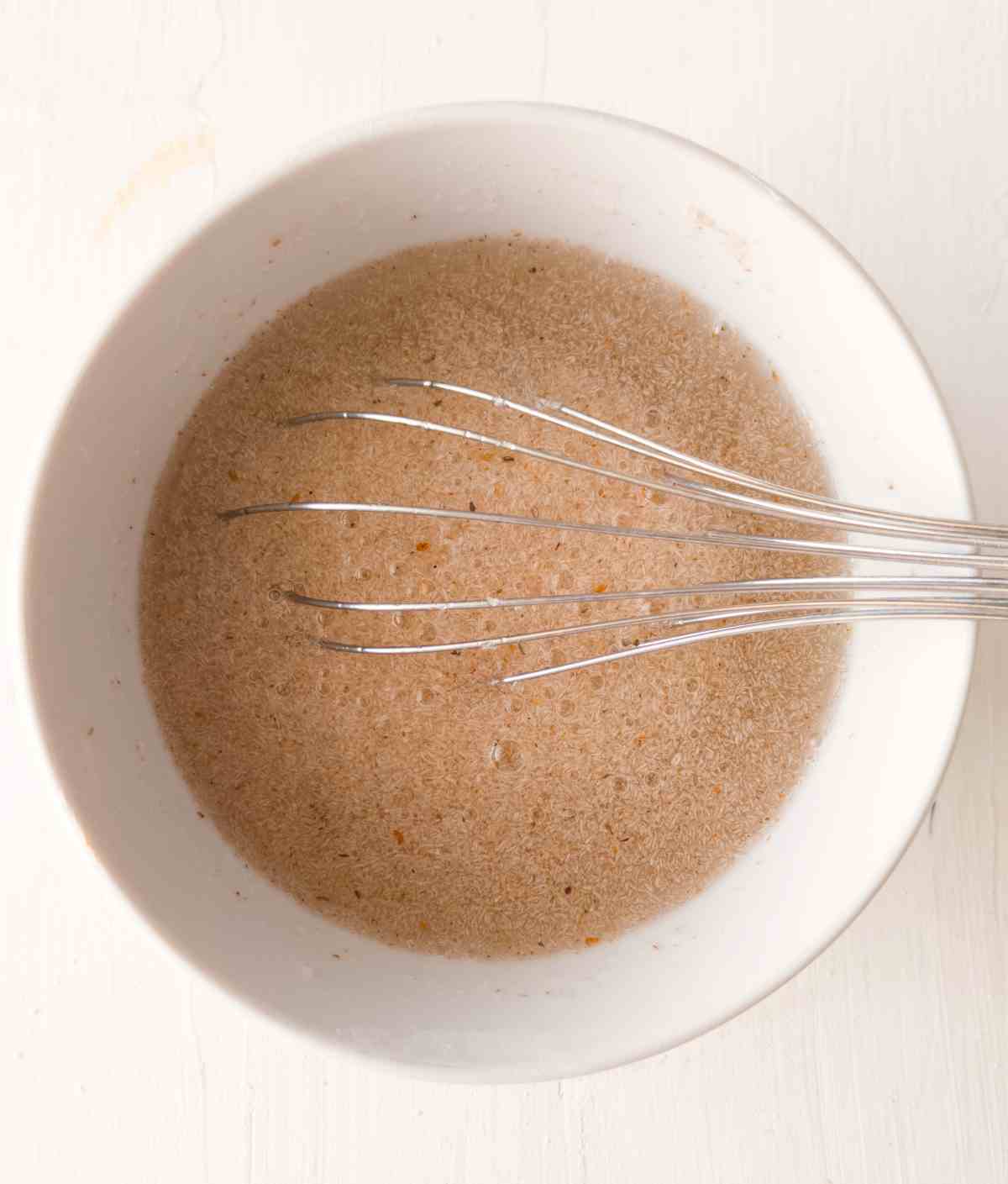
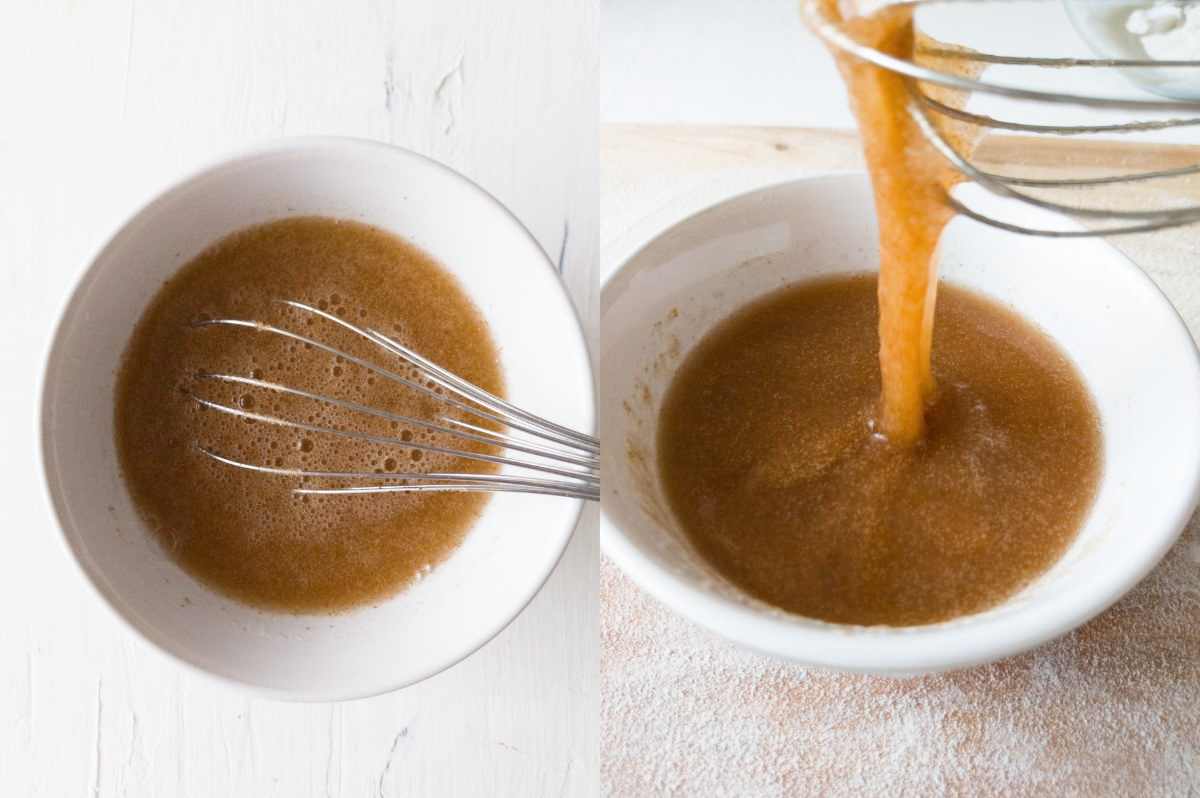
Combine psyllium husk, sugar, and room temperature/warm water in a medium-sized bowl, whisk to incorporate, and set aside.
Step 2
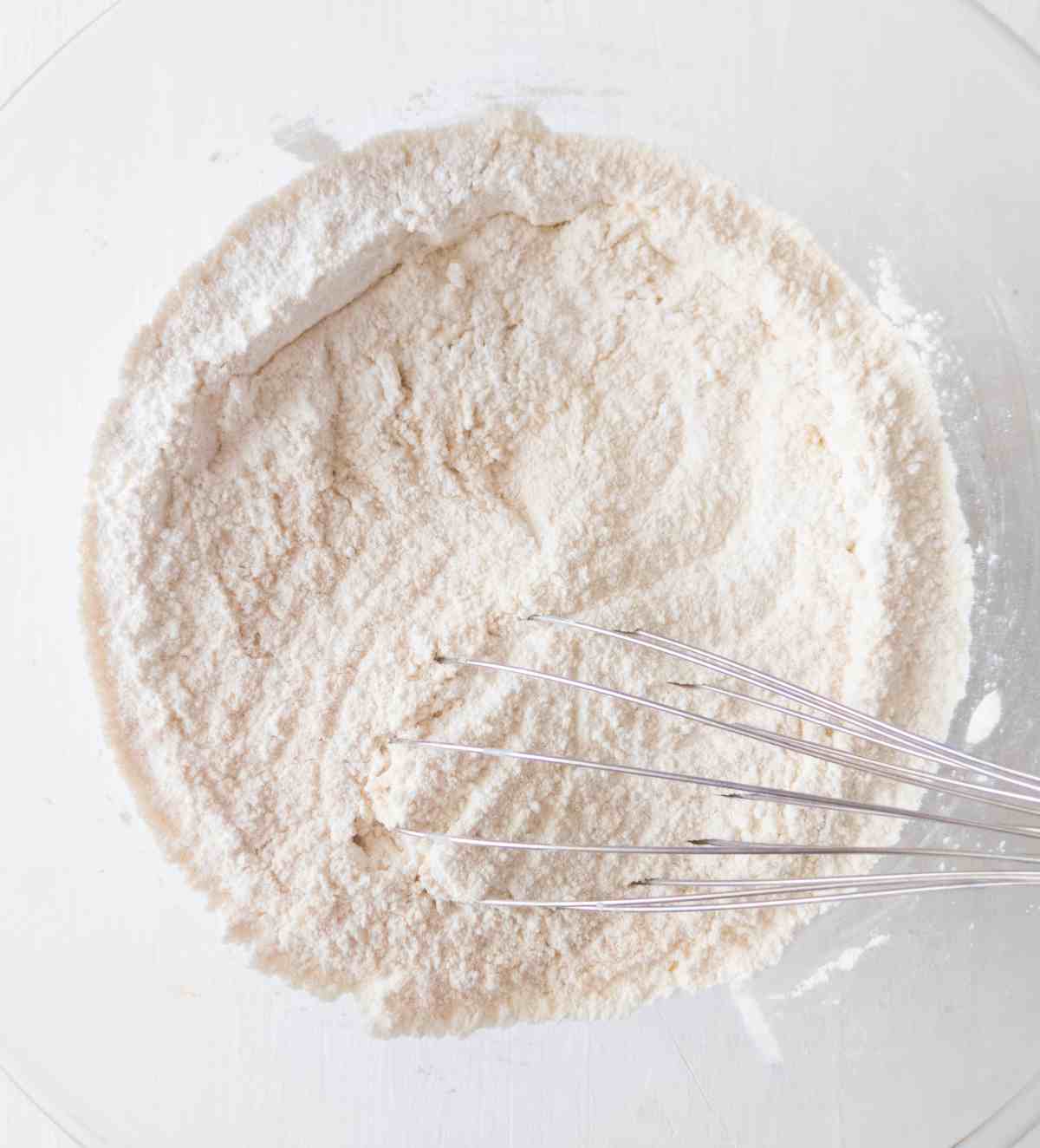
In a large mixing bowl combine all the dry ingredients (sorghum flour, starches, baking powder, and salt) and whisk to incorporate.
Step 3
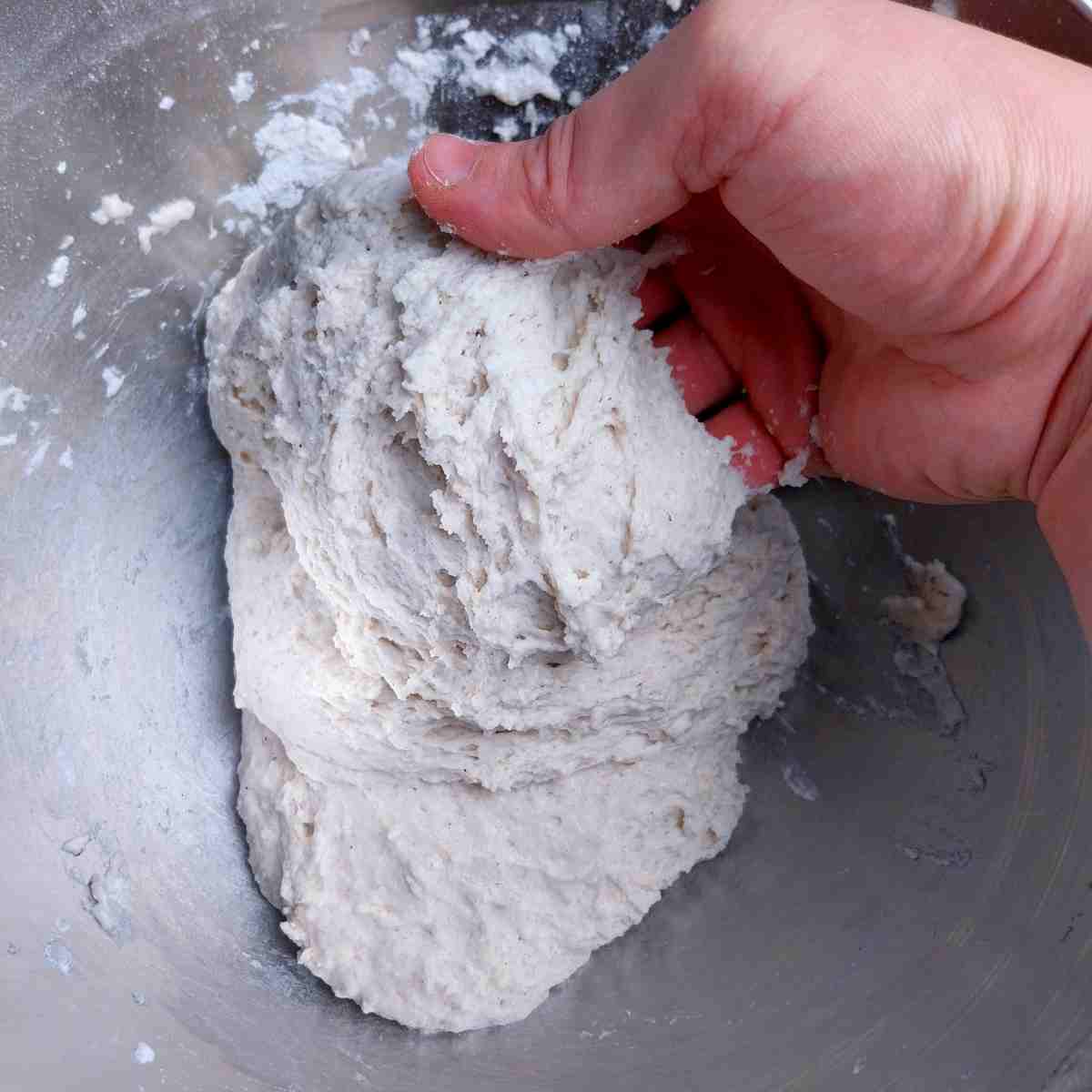
Once psyllium forms a gel, add it to the bowl with the dry ingredients.
Add mature gluten-free sourdough starter to the bowl and mix the dough thoroughly.
I like to use an electric mixer for this step but you can also do it by hand if you prefer.
Step 4
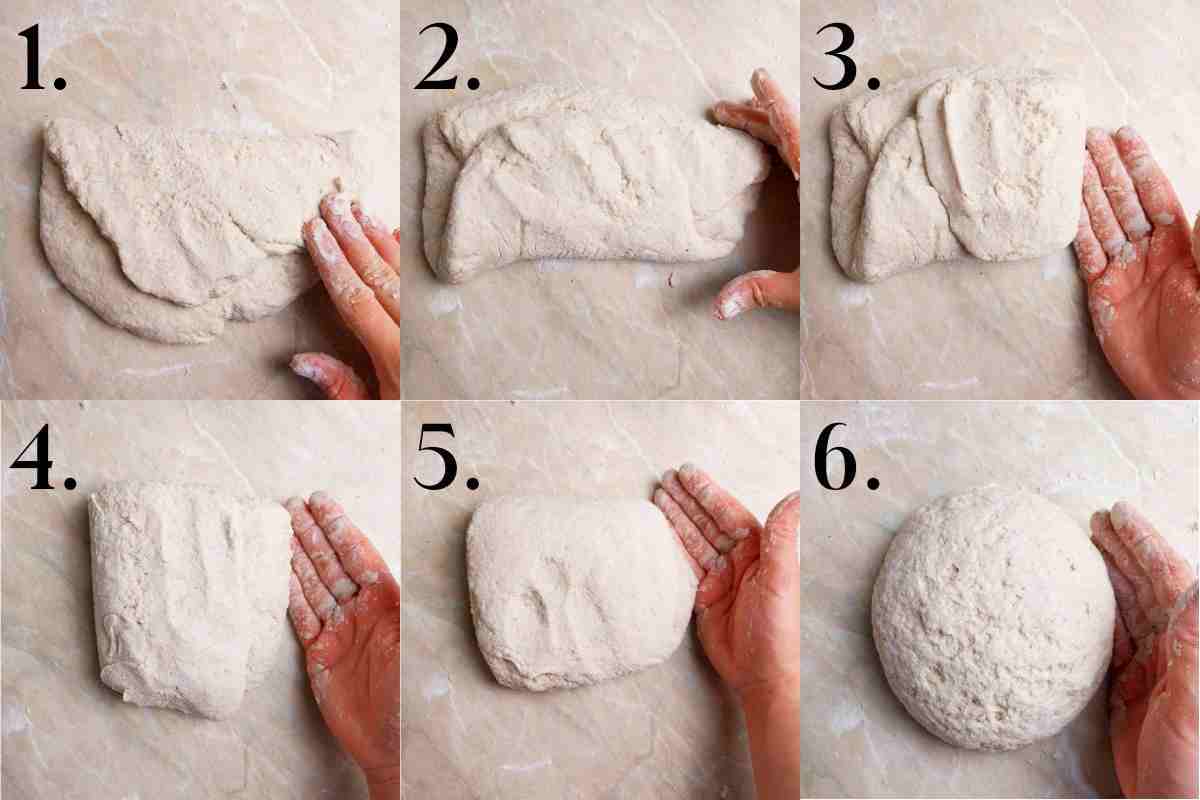
Once the dough is well incorporated, turn it over onto a lightly floured working surface and flatten it into a disc.
Fold each side of the disc onto its middle, flip the dough, and shape it into a ball (refer to the pictures for visual instructions).
Step 5
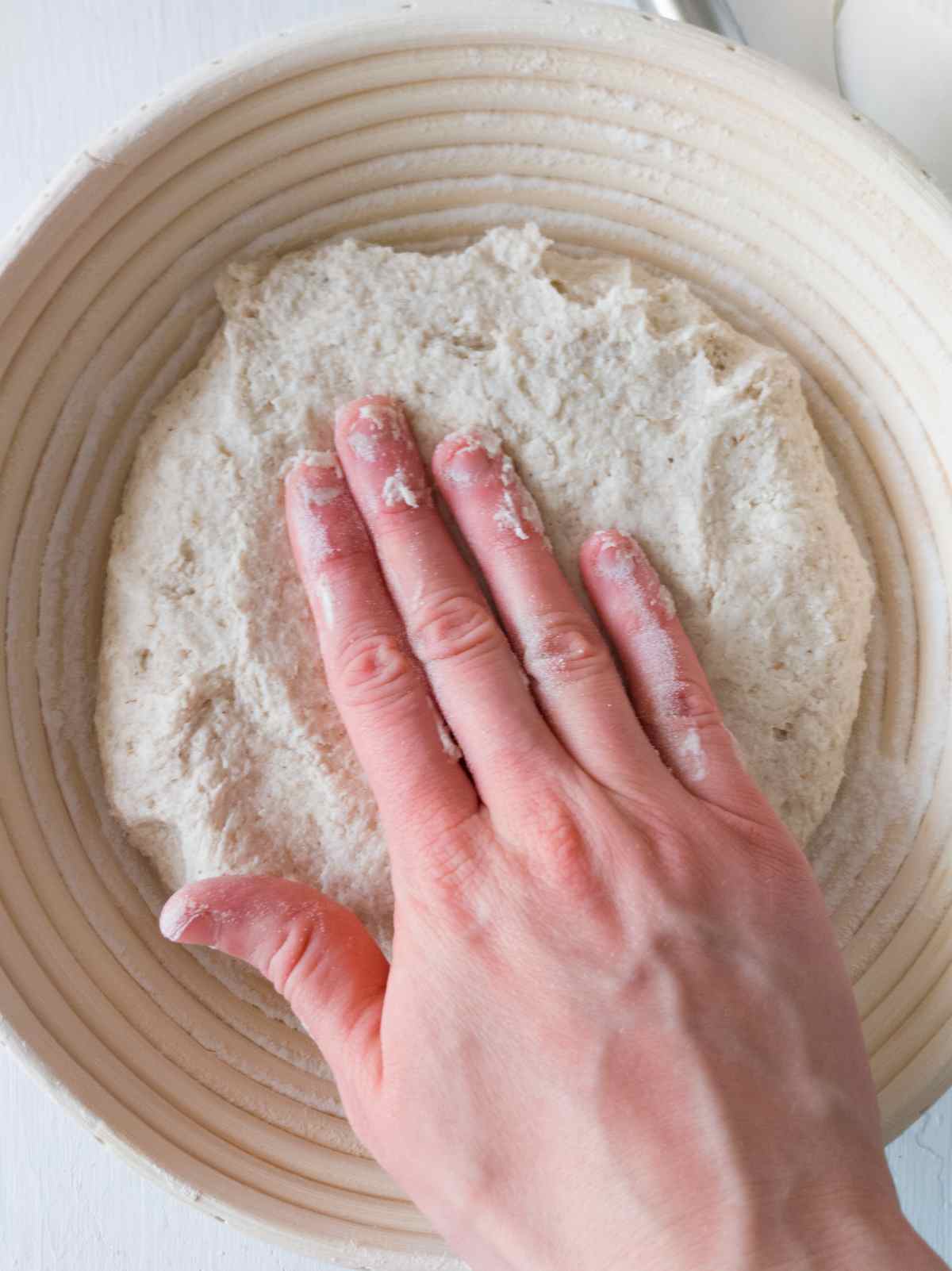
Flour the proofing basket or bowl lined with a kitchen towel and place the dough in it. Press the dough into the basket to create a flat top.
Cover the basket with a kitchen towel and leave to rise at room temperature for about 5 hours or in the refrigerator overnight (12-18 hours).
The dough should puff up during rising but it won't double in size. Don't worry if the dough doesn't rise a whole lot, it will do most of its job in the oven.
Step 6
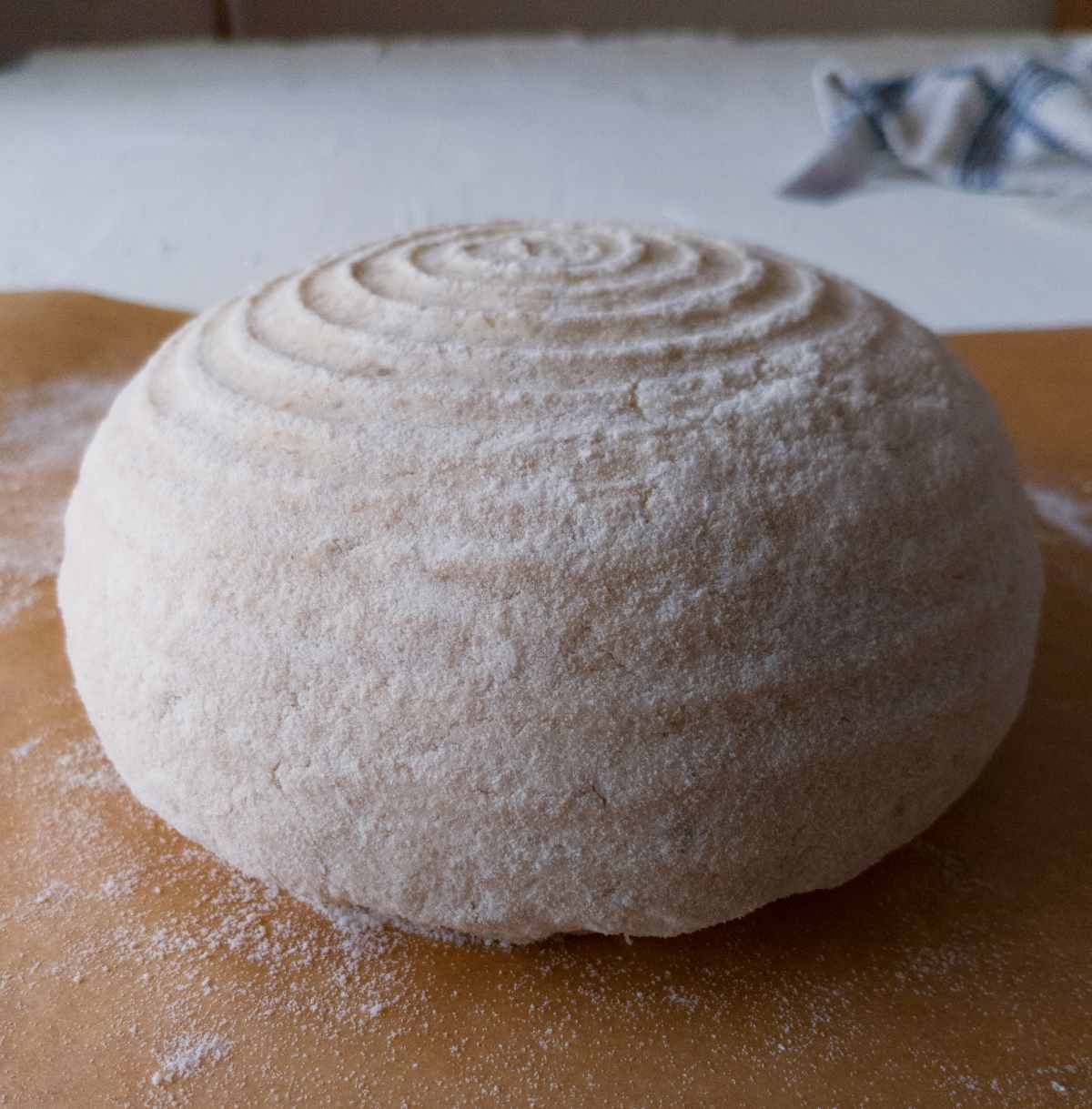
Once the dough has been proofed, gently turn it over onto the working surface.
Carefully shape the dough into a tighter ball by turning the dough around and tucking its sides under itself.
Don't push the dough too hard to avoid losing the air bubbles formed during fermentation.
Step 7
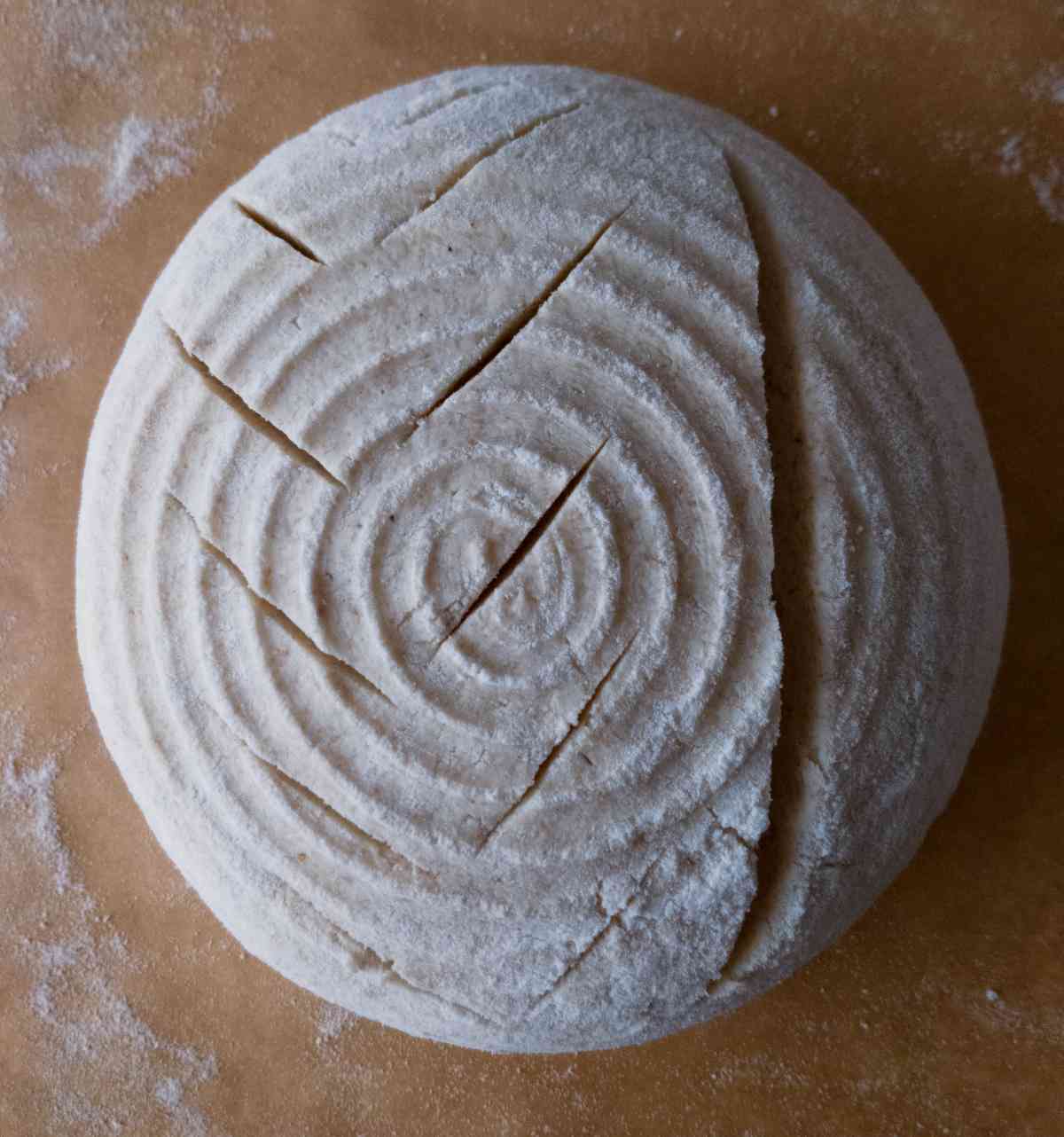
Score the dough with a razor, a lame, or a sharp knife (be creative and make a nice pattern!). Scoring allows for a better oven spring.
Transfer the dough onto a piece of parchment paper and gently lower it into the cold Dutch oven.
Place the Dutch oven with the bread into the oven and start preheating it to 450F/230C. Once the oven is heated, bake for 40 minutes with the lid on.
Then, take the lid off, turn the temperature down to 350F/175C, and bake for another 30 minutes.
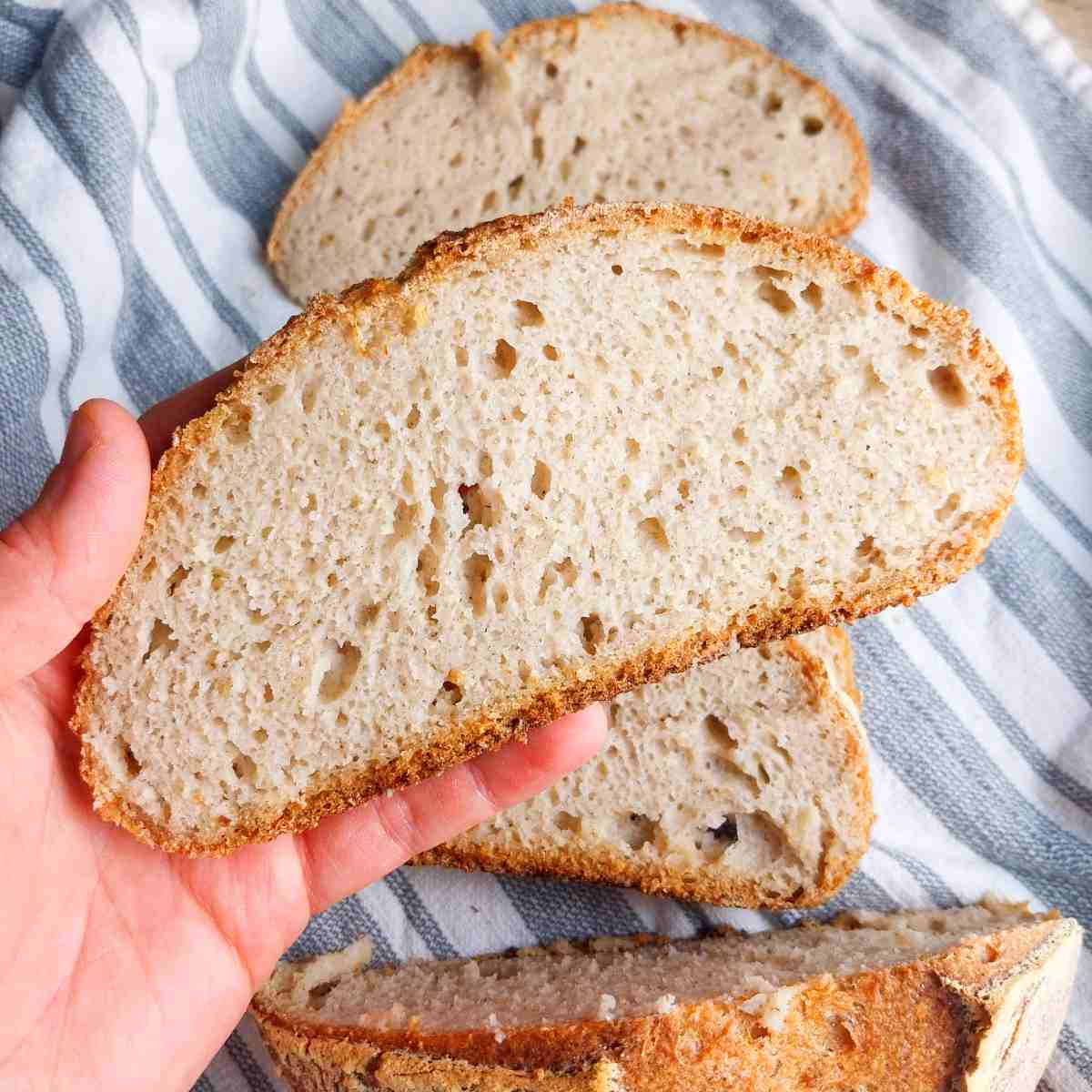
Transfer the bread onto a cooling rack and wait until it is no longer warm to the touch to slice it. Enjoy!
Troubleshooting
Gumminess - if your bread is gummy it might be due to underproofing/overproofing or not baking long enough. If you used other flour types than indicated in the recipe, you might need to adjust the water amount next time.
Too dense - if the bread doesn't have any bubbles and seems way too dense it could be due to a starter that isn't active enough or the cold proofing temperature.
A large hole in between the top crust and the crumb - this is a sign of overproofing the dough. Bake the dough sooner next time!
Frequently Asked Questions
Yes! Gluten-free starters won't always double and depending on the consistency, it might rise very little. You can still use it in bread as long as it is at least 2 weeks old!
You can give it a try but your bread might turn out gummier/drier depending on the contents of that flour blend.
I don't recommend making gluten-free sourdough in a bread machine due to its proofing timing and specific baking needs. Instead, check out these gluten-free bread machine recipes for ideas!
More Gluten-Free Sourdough Recipes to Try


Get my GF sourdough recipes eBook
The top 16 recipes of 2024!
Gluten Free Vegan Sourdough Bread
Ingredients
Wet ingredients
- 20 grams (3 tbsp) psyllium husk, whole husks, if using coarse powder use 20 grams, fine powder - 17g. For more details check my psyllium husk 101 article
- 410 grams (1⅔ cups) water, room-temperature
- 15 grams (1tbsp + 1tsp) sugar/maple syrup, helps the sourdough bacteria
- 70 grams (¼ cup) active sourdough starter
Dry ingredients
- 85 grams (¾ cup) tapioca starch or arrowroot starch
- 95 grams (½cup + 1tbsp) potato starch or 95g (¾ cup) cornstarch
- 180 grams (1⅓ cups) sorghum flour
- 12 grams (2 tsp) salt
- 2 teaspoon baking powder, check the package to make sure it is gluten-free
SAVE THIS RECIPE!💌
Instructions
- Combine psyllium husk, sugar, and room temperature/warm water in a medium-sized bowl, whisk to incorporate, and set aside.
- In a large mixing bowl combine all the dry ingredients (sorghum flour, starches, baking powder, and salt) and whisk to incorporate.
- Once psyllium forms a gel, add it to the bowl with the dry ingredients.Add mature gluten-free sourdough starter to the bowl and mix the dough thoroughly.I like to use an electric mixer for this step but you can also do it by hand if you prefer.
- Once the dough is well incorporated, turn it over onto a lightly floured working surface and flatten it into a disc.Fold each side of the disc onto its middle, flip the dough, and shape it into a ball (refer to the pictures in the post for visual instructions).
- Flour the proofing basket or bowl lined with a kitchen towel and place the dough in it. Press the dough into the basket to create a flat top.Cover the basket with a kitchen towel and leave to rise at room temperature for about 5 hours or in the refrigerator overnight (12-18 hours).The dough should puff up during rising but it won't double in size. Don't worry if the dough doesn't rise a whole lot, it will do most of its job in the oven.
- Once the dough has been proofed, gently turn it over onto the working surface.Carefully shape the dough into a tighter ball by turning the dough around and tucking its sides under itself.Don't push the dough too hard to avoid losing the air bubbles formed during fermentation.
- Score the dough with a razor, a lame, or a sharp knife (be creative and make a nice pattern!). Scoring allows for a better oven spring.Transfer the dough onto a piece of parchment paper and gently lower it into the cold Dutch oven and put the lid on.Place the Dutch oven with the bread into the oven and start preheating it to 450F/230C. Once the oven is heated, simply bake for 40 minutes without opening the oven.Then, open the oven, take the lid off, and transfer the loaf onto the oven rack. Turn the temperature down to 350F/175C and bake for another 30 minutes.Transfer the bread onto a cooling rack and wait until it is no longer warm to the touch to slice it. Enjoy!*If the bottom of your bread tends to burn, place a baking sheet in the bottom of the oven once you take the bread out of the Dutch oven.



David Kouri says
I was wondering if adding the olive oil at the same time as the psyllium husks are being hydrated would hinder their water absorption? I have been allowing the psyllium to gel then add the oil. What are your thoughts?
Natasha Levai says
You are right that psyllium husk doesn't interact with oil the same way it does with water! So, if you want to, you can add it later, but I find that the amount of oil is insignificant to inhibit the formation of psyllium gel! So, I prefer to add them together because otherwise I tend to forget to add it at all. 🙂
L says
Thank you so much for this recipe! I have never done any sourdough baking before and this recipe was the first thing I've tried. It came out wonderful and the flavor and crust is delicious! My mom has several autoimmune issues and cant have gluten or commercial yeast so she hasn't had bread in years. She loves this bread and so do I. Thank you for helping me bring bread back in to her life! 😀
I'd also like to add that for anyone curious, I used tapioca and arrowroot starch instead of potato starch and it tastes great.
Natasha Levai says
Hi Lena! I am so happy to hear your mom can eat bread again! Yay! Thank you for sharing this!
Chiara says
I'm really excited to try this recipe. Your instructions say Millet Flour but your recipe says Sorghum flour and Millet flour is not mentioned in the recipe. Is it the same thing?
Natasha Levai says
Hi Chiara! I switched to using sorghum flour because the results were much better than with millet! I probably forgot to edit it in all the places within the post, tank you for pointing it ou!
Stacie says
I just got a millet starter up and running, do you think that will work for this recipe? I am also wondering what is the purpose of the sorghum flour, and is there a substitute for that you could recommend? I have quite a few flours and starches on hand but not that one. Thank you!
JJ says
Have you experimented with konjac vs psyllium? If so what was your experience?
Natasha Levai says
Hi JJ! No, I have not experimented with konjac as I have never seen it available in the stores where I buy my ingredients!
Liene says
Can I replace cornstarch/potato starch with just all tapioca starch?
Also do you recon it would work in bread machine setting 'bake' or air fryer regular setting? I know, I know it's not ideal just wondering if it's even worth the effort to try or will it be complete fail...
Natasha Levai says
I don't recommend using a bread machine for multiple reasons! And yes, you can substitute the starches!
Lena says
Hi Natasha!
I have a quick question. I’ve tried several different gluten free breads, and they all taste ok but are gummy. I understand that gluten free bread is more gummy, but was hoping to find a less gummy bread. Is your bread a bit gummy too? Thanks so much!
Natasha Levai says
I am afraid, it can be a bit gummy. I have been trying to find the perfect balance between moist/not gummy but a lot of times it does turn out slightly gummy.
Lena says
Thanks so much for responding so quickly! I’ll give your recipe a try as well and see how we like it 🙂
Illene says
Has anyone let this proof in a loaf pan, skipped the final shaping, and baked it in the same loaf pan?
Natasha Levai says
Yes, I tried baking it that way! It works just fine!
Katherine Britton says
Awesome! How do you adjust the bake time for a loaf pan instead of a Dutch oven?
Natasha Levai says
I recommend adding more water to the loaf, instead of 300g, add 400-450g and bake in the loaf pan for the same about of time. First stage 30 minutes and the second one 40 at a lower temperature!
Angie says
I can't do corn or potato starch, any suggestions? Would more tapioca or arrowroot work?
Natasha Levai says
Yes! You can substitute potato starch for any other starch (cornstarch, tapioca, arrowroot). The substitution is 1:1, so if the recipe calls for 100g potato starch, use 100g of any other starch of choice!
Tam Lee says
if I proof overnight in the fridge do I skip the room temperature proofing?
Natasha Levai says
You can! Although I find that my bread proofs better at room temperature.
Jane Manich says
Hi Natasha❤️ I’m an newbie and am very close to making your GF sourdough bread. after proofing over night in the refrigerator, do I bake directly from the refrigerator, placing the scored bread into the preheated cast iron Dutch oven? Or do I let the dough warm up in proofing box a bit?
Thank you for all you do for this community
Jane
Natasha Levai says
Hi Jane! There is no need to in warming it up, so you can bake straight from the fridge!
Christy says
I have tried numerous loaves of gluten free sourdough since I started my sourdough journey. This one is the best so far. Whole family loved it and it came out fantastic. I am still working on how to not burn the exterior crust. So we are baking at 440 today. Because I think I’m realizing thanks to your post that my oven runs hot. Also my Dutch oven is cast iron, so I wonder if that gets hotter than a ceramic one as well. Every new loaf is a learning experience. Thank you for this bread.
Natasha Levai says
Hi Christy! Thank you so much for your feedback. I find that if I take my bread out of the Dutch oven after the first 40 minutes and continue baking it on the rack then it doesn't burn most of the times. I am also using a cast iron Dutch oven! Lowering the temperature might also be a good idea. Hope you find what works for you!
Lisa says
Can I use tapioca flour instead of tapioca strarch?
Natasha Levai says
Hi Lisa! Tapioca flour and tapioca starch are essentially the same thing, so, yes, you can use them interchangeably. 🙂
Kylene says
Do you use a recently fed or unfed starter?
Can I use my starter if it already fell?
Natasha Levai says
You can use a starter that has been fed at least 3-4 hours ago. It is ok if it already fell, that is not a problem. It is best to use it at its peak but that doesn't mean you won't get great bread with a starter that already fell or even was fed 24 hours ago and fell a long time ago. I made bread with all kinds of starters and it worked! The only starter I would not recommend is the one right out of the fridge.
Kylene says
Excellent! I ended up feeding my starter right after I posted. Now it's time to try your recipe for the first time!
Thank you for posting! I'll let you know how it goes.
Courtney Lynn says
Right now I am letting the levain sit. On the next steps under "preparing the dough", step 1 says mix psyllium husk etc, do I mix these into the levain bowl? Seperate bowl? Then mix levain, wet mix, and dry mix together at the end step of preparing the dough? I don't wanna mess this up!
Natasha Levai says
Hi Courtney! It is best to mix everything separately. Let the levain sit and do its work, once it is ready, mix the psyllium gel in a separate bowl. Mixing psyllium husk with levain will make the formation of the gel much slower.
Randi says
I love this bread and am so happy I found this website! This is my 2nd time baking this. I think I might’ve gone overboard yesterday though- baking this bread, the sourdough buckwheat bread and the sourdough banana muffins all in the same day!
Now I need to try to not eat them too quickly!
Natasha Levai says
Yay! Thank you so much for your feedback, Randi!
Maria Khan says
Sourdough Bread looks great
Natashashome says
Thank you!
Mackenzie says
Best gluten free bread I've ever eaten! Thank you for such a great recipe. I love that you explain what each ingredient does and also have so many substitutions.
Natasha Levai says
Hi Mackenzie! Thank you so much for your feedback! I am so happy it worked for you.
Margaret Mather says
I followed the recipe, but subbed Psyllium with Ground Flaxseed. The dough was really moist and puddling, so I added just a bit of GF AP flour and it tightened up. Fingers crossed! I really would like this be a success.
Natasha Levai says
i Margaret! Ground flaxseed is not a good substitute for psyllium in bread, unfortunately! There isn't really a good swap for psyllium in this recipe.
Wednesday Sorokin says
This is excellent! I’ve been making gf breads for years and this is the first sourdough that didn’t come out sticky or gummy. It also tastes delicious. I replaced half of each flour/starch with Caputo’s gluten free wheat flour mix just because I’m liking it so much but I can tell it would be great just as written. Thanks for a great recipe!
Natasha Levai says
So happy you liked the recipe!