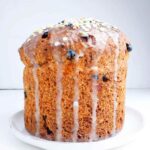
Gluten-Free Easter Bread
This delicious gluten-free Easter bread has a tender and moist crumb and a rich flavor. Every bite is bursting with a sweet raisin and candied peel sweetness! This bread is also knows as Ukrainian Paska (or Kulich).
Servings: 1 Paska
Calories: 3197kcal
Cost: 5
Equipment
Ingredients
Psyllium Gel
- 16 grams psyllium husk
- 360 grams water
Dry ingredients
- 90 grams tapioca starch/flour
- 100 grams potato starch
- 160 grams sorghum flour
- 110 grams sugar
- 7 grams instant yeast
- 8 grams baking powder
- 6 grams xanthan gum
- 6 grams salt
Wet Ingredients
- 1 egg
- 2 egg yolks
- 70 grams oil any neutral seed or vegetable oil
- 1 teaspoon vanilla paste or extract
Add-Ins
- 50 grams raisins
- 50 grams candied citrus peel or other dry candied fruit
Icing
- ⅔ cup powdered sugar
- 2-3 teaspoon lemon juice add more as needed
- sprinkles to taste
Instructions
- Add the water and psyllium husks to a medium-sized mixing bowl and whisk to incorporate.Note: the warmer the water, the faster the psyllium gel will set. If you're using psyllium powder, use colder water to prevent clumping.16 grams psyllium husk, 360 grams water
- In a large mixing bowl, add all of the dry ingredients and whisk well to combine.90 grams tapioca starch/flour, 100 grams potato starch, 160 grams sorghum flour, 110 grams sugar, 7 grams instant yeast, 8 grams baking powder, 6 grams xanthan gum, 6 grams salt
- Add psyllium gel and all the wet ingredients to a large mixing bowl and whisk to incorporate. You can whisk by hand or use an electric mixer.1 egg, 2 egg yolks, 70 grams oil, 1 tsp vanilla paste or extract
- Add the dry and wet ingredients together and mix until evenly combined. You can use an electric mixer with dough hooks or a wooden spoon for this step. The dough will be wet and sticky but avoid the temptation to add extra flour.
- Place the raisins in a small bowl and pour boiling water over them to soak. Let the raisins soak for 5 minutes. In the meantime, chop the candied citrus peel into small pieces.50 grams raisins, 50 grams candied citrus peel
- Strain the raisins and add them to the paska dough together with the chopped candied peel. Fold them into the dough with a silicone spatula.
- Transfer the Paska dough into a panettone paper mold (I used a 5.11x3.74 in/500g size) and smooth the top out with a wet silicone spatula. Cover the dough with a kitchen towel and place into a draft-free warm area to rise.This stage might take anywhere from 1h to 2.5h, depending on how warm it is. Let the dough rise until the tip is about an inch or two above the paper mold, don't let the dough double in size or it will collapse during baking.
- Preheat the oven to 350F/175C and bake gluten-free Easter bread for 1h on the middle rack. Check on the bread 30 minutes into baking and cover with foil if the top starts to brown too much.
- Once ready, turn off the heat and open the oven door. Let the paska bread cool inside the oven until no longer warm to the touch. The Easter bread is too delicate to handle right after baking, so it is crucial to let it sit in the oven for a few hours to chill.
- Once the gluten-free Easter bread is completely cool, prepare the sugar icing by mixing powdered sugar with lemon juice. Top the paska bread with the icing and add sprinkles for an authentic Slavic look!Slice and enjoy!⅔ cup powdered sugar, 2-3 tsp lemon juice , sprinkles to taste
Notes
Expert Tips:
- Don't open the oven door in the first 30 minutes of baking to prevent gluten-free Easter bread from collapsing.
- The bread will rise a lot during baking and deflate some once it's done. This is normal and should not cause gumminess in the dough. Slight deflating is typical for enriched dough, just like in my gluten-free fluffy sourdough recipe.
- Don't handle the gluten-free paska until it is completely cool, or it might get deformed.
- Grease the panettone paper mold with non-stick spray to make removing the paper easier.
- Don't add too many add-ins, or the dough won't rise as well. This is generally true for gluten-free bread like this gluten-free cinnamon-raisin sourdough!
- If the crumb is gummy or wet after the bread is cooled down, reduce the water by 10g next time.
- Let Paska cool down completely;
- Slice it and place it into freezer-safe bags or containers;
- Squeeze out as much air as possible and seal the bags/containers;
- Label the cake with the date and keep for up to 3 months.
Nutrition
Serving: 2medium slices | Calories: 3197kcal | Carbohydrates: 582g | Protein: 35g | Fat: 91g | Saturated Fat: 11g | Polyunsaturated Fat: 24g | Monounsaturated Fat: 52g | Trans Fat: 0.3g | Cholesterol: 552mg | Sodium: 3576mg | Potassium: 2165mg | Fiber: 39g | Sugar: 236g | Vitamin A: 767IU | Vitamin C: 10mg | Vitamin D: 3µg | Calcium: 714mg | Iron: 12mg
