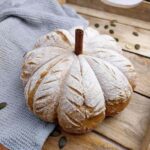
Gluten-Free Pumpkin Sourdough Bread
Pumpkin puree tenderizes the crumbs and balances out the flavors making this bread a great addition to a Thanksgiving table!
Servings: 1 loaf
Calories: 1578kcal
Cost: 5
Equipment
- banneton basket (optional)
- dutch oven (highly recommended)
- Threads for decoration
- kitchen towels
Ingredients
Wet Ingredients
- 20 grams whole psyllium husks I haven't tested this bread with psyllium powder
- 310 grams water you might need more water if using store bought pumpkin puree
- 15 grams sugar or honey, maple syrup, or coconut sugar
- 70 grams active gluten-free sourdough starter
- 120 grams pumpkin puree not pumpkin pie filling
Dry Ingredients
- 85 grams tapioca starch or arrowroot starch
- 95 grams potato starch or cornstarch
- 180 grams sorghum flour
- 10-12 grams salt
- 2 tsp baking powder make sure it is gluten-free
Instructions
- First, add the water and psyllium husk to a medium-sized bowl and whisk to incorporate. Add sugar or honey and set aside to let the gel form (2 minutes).
- In the meantime add the flours, baking powder, and salt to a large mixing bowl and whisk thoroughly to combine.
- Add the pumpkin puree (make sure it is not hot), sourdough starter, and psyllium gel to the bowl with the dry ingredients and mix using an electric mixer with dough hooks or do it by hand.The dough will be sticky but workable. Mix until the dough is evenly incorporated and no flour lumps remain. Then add toasted pumpkin seeds if using and mix again.
- Turn the dough onto a lightly floured working surface and press it into a large rectangular. Roll the dough the longer side up, then turn and roll the dough up from the other side.Shape it into a ball by turning the dough with the palms of your hands until it looks smooth.
- Fermentation. Place the dough into a floured banneton basket or a mixing bowl lined with a kitchen towel.Cover the dough and let it ferment until slightly puffed up (about 5-7 hours at room temperature or 12-18 hours in the refrigerator). The dough won't rise much and definitely won't double in size but it should look slightly bigger than before proofing.
- Once the bread is done fermenting, place four long threads on top of it intersecting in the middle (see the pictures for a visual).
- Then take a piece of parchment paper, gently press it onto the top of the loaf, and carefully flip the dough onto it (with the threads in place).Tie the threads on top into a double knot and generously dust the boule with rice flour.
- Score the dough into a pattern you prefer and then lower the dough with the parchment paper into the Dutch oven.I like baking with a cold start (preheating the oven with the bread in it) but you can preheat the oven ahead of time if that works better for you. For the cold start, place the cold Dutch oven with the lid on into a cold oven and start preheating to 450F/230C.Once the oven is preheated, start the timer and bake for 40 minutes. Then, take the lid off, lower the temperature to 350F/275C, and bake for another 30 minutes.Alternatively, you can simply place the dough into a preheated oven at 450F/230C.
- Once the bread is done baking, transfer it onto a cooling rack and let it sit until no longer warm to the touch (a few hours). Cut off the threads and carefully pull them away from the crust. Insert a cinnamon stick into the middle of the bread for decoration! Enjoy!
Notes
Storage
This bread is best on the day of baking but you can freeze it if you aren't planning on eating it all on the first day!
To freeze, slice the bread and place the slices into a freezer-safe zip-lock bag or container, label, and keep for up to 3 months. Make sure the bread is cooled completely before transferring it to the freezer.
To defrost, simply put a slice or two into the microwave for a couple minutes.
Alternatively, you can keep this bread at room temperature for up to 3 days.
Troubleshooting & Tips
The bread is gummy on the bottom - it could be due to the heat not being transferred to the bread as much as it should be. Make sure you are baking in a cast iron Dutch oven!
The bread didn't rise during proofing - make sure the temperature is warm enough (75F/24C is ideal) and your starter is active.
A large hole in between the top crust and the crumb - this is a sign of overproofing the dough. Bake the bread sooner next time!
Gummy crumb - this could be due to extra moisture in your starter or pumpkin puree. Try reducing water next time or simply toast the slices!
Nutrition
Serving: 1slice | Calories: 1578kcal | Carbohydrates: 364g | Protein: 25g | Fat: 8g | Saturated Fat: 1g | Polyunsaturated Fat: 3g | Monounsaturated Fat: 2g | Sodium: 4808mg | Potassium: 1879mg | Fiber: 37g | Sugar: 26g | Vitamin A: 18676IU | Vitamin C: 9mg | Calcium: 660mg | Iron: 11mg
