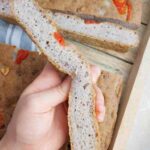
Buckwheat Focaccia (GF & Vegan)
This delicoius gluten-free buckwheat flour focaccia is perfectly crusty with a soft and fluffy crumb.
Servings: 8 slices
Calories: 247kcal
Cost: 5
Ingredients
Wet ingredients
- 20 grams whole psyllium husks or 18g psyllium powder
- 500 grams water
- 30 grams olive oil
Dry ingredients
- 300 grams light buckwheat flour
- 100 grams sorghum flour or brown rice flour or more buckwheat flour
- 10 grams salt
- 7 grams instant yeast not active dry yeast
You will also need
- 2 tablespoon olive oil for topping
- toppings of choice tomatoes, onions, garlic, olives, etc.
- flaky salt for topping
Instructions
- First, add psyllium husk to a medium-sized bowl and pour the water over it. Incorporate with a whisk immediately to prevent lumps from forming. Add olive oil and set the mixture aside to let a gel form (2 min).20 grams whole psyllium husks, 500 grams water, 30 grams olive oil
- In a large mixing bowl add the buckwheat flour, sorghum flour, salt, and instant yeast, and whisk to combine.300 grams light buckwheat flour, 100 grams sorghum flour, 10 grams salt, 7 grams instant yeast
- Note: if you are using active dry yeast, you will need to activate it before using. Take some of the water called for in the recipe, warm it up, and let the yeast sit in it for 10 minutes until frothy.
- Add psyllium gel to the bowl with dry ingredients and mix the dough.
- You can use an electric mixer with dough hooks, a wooden spoon, or your hands. Mix until no lumps remain.For a smoother dough use an electric mixer for about 5 minutes.
- Transfer the dough to a lined or greased baking dish (I used a 12x8in/30x22cm baking dish). Smooth the dough out and cover with a kitchen towel. You can use a ceramic, a glass, or a metal baking dish. If your baking tray is smaller, the focaccia will be taller, if it is larger, the focaccia will be thinner.
- Place the baking dish into a warm spot (24C/75F) for about 1h to proof. Focaccia will puff up but might not double in size.
- Start preheating the oven to 400F/200C about 40 minutes into proofing. Once the dough is done rising, drizzle the top of it with 2 tablespoon of olive oil and poke holes in it with your fingers.You can poke holes by clawing four of your fingers into the dough all over the surface (the fun part!). Press your toppings into the dough (olives, cherry or sundried tomatoes, fresh herbs, etc.), sprinkle with flaky salt, and bake for about 30 minutes. For thicker crust bake for additional 5-10 minutes. Let the focaccia cool completely before slicing to avoid gumminess. Enjoy!
Notes
Storage
-
- Buckwheat focaccia will keep at room temperature for 3-4 days. Store it in a bread bag or a box to prevent it from going stale.
-
- To keep focaccia fresh for longer, slice and freeze it for up to 3 months. Place the slices into zip-lock bags or freeze-friendly containers and label them.
-
- To defrost, place a slice or two into the microwave for a minute.
-
- Rosemary and flaky sea salt;
-
- Garlic with thyme and oregano;
-
- Olives and capers;
-
- Tomatoes, basil, and grated Parmesan or mozzarella;
-
- Sun-dried tomatoes with pesto.
-
- Dip it in olive oil with salt.
-
- Eat it with marinara or bolognese sauce.
-
- Dip it in soups like this Ukrainian borsch or creamy cheddar broccoli soup.
-
- Use it as a pizza base and bake until the toppings have set and the cheese melted.
-
- Use it as sandwich bread!
-
- Gummy crumb - this could happen if you use cold water or bake the focaccia bread too soon. Make sure your yeast is active!
-
- The crust is too hard - bake 5-10 minutes less next time.
-
- The dough is too wet or too dry - make sure you measure the ingredients by weight and not by volume (digital scale, not cups).
Nutrition
Serving: 1slice | Calories: 247kcal | Carbohydrates: 39g | Protein: 6g | Fat: 9g | Saturated Fat: 1g | Polyunsaturated Fat: 1g | Monounsaturated Fat: 6g | Sodium: 493mg | Potassium: 264mg | Fiber: 7g | Sugar: 1g | Vitamin C: 0.003mg | Calcium: 27mg | Iron: 2mg
